How Fleet Safety Impacts Your Bottom Line

How Fleet Safety Impacts Your Bottom Line
Fleet safety impacts your bottom line by lowering the costs that follow every collision, violation, and driver departure: insurance premiums, claims, legal exposure, fuel waste, downtime, and hiring. When you prevent risky driving and recognize safe driving, you cut those costs while protecting your drivers and building a reputation that wins customers.
Trucking costs keep climbing. ATRI's 2026 operational costs report found the industry-average cost to operate a truck reached $2.336 per mile in 2025, up 3.4% from the previous year and the highest in the report's history. Excluding fuel, costs rose 4.2% to $1.854 per mile. When margins are this thin, every avoidable crash, claim, and violation hits harder.
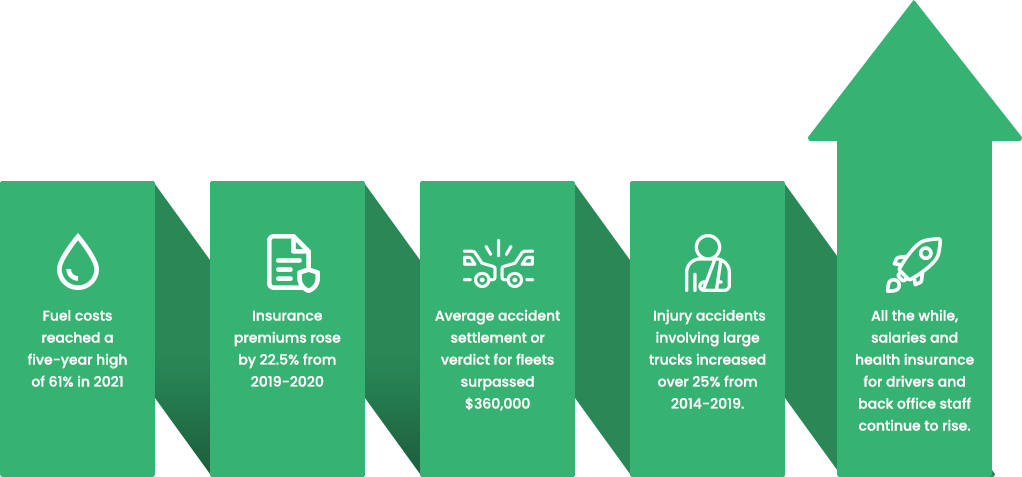
Insurance is one of the fastest-moving line items. Liability and cargo premiums rose 3.9% in 2025 to about $0.11 per mile, and first-quarter 2026 data showed premiums up another 6.4%. Crash exposure hasn't eased, either: the number of large trucks in injury crashes rose 5.4% to 120,724 in 2024, according to the National Safety Council. Driver costs are climbing, too: ATRI found driver benefits rose 6.6% in 2025.
A proactive fleet safety program can turn those pressures into savings. Today's AI dash cams do more than record events. Netradyne's Driver•i analyzes 100% of driving time, detects risky behaviors like distraction and tailgating as they happen, and recognizes safe driving, so you can coach drivers, prevent incidents, and reduce costs.
Benefits of AI Dash Cams for Fleet Safety and Cost Reduction
When budgets tighten, safety shouldn't be the first line item you cut. In fact, your safety initiatives can be a cost-saving opportunity. AI dash cams can help turn your safety department from a cost center into a cost saver. They increase efficiency, reduce costs, and strengthen your reputation and brand image, which can help you win more customers.
Increase Operational Efficiency with AI Dash Cams
AI-powered safety systems can help you run a more efficient operation. That can mean quicker delivery turnarounds, better tracking, and clearer communication between managers and drivers. Because Driver•i processes video on the device with edge AI, drivers get immediate in-cab audio alerts, and managers see prioritized events instead of hours of raw footage.
Reduce Fleet Operating Costs and Win More Customers
Improving efficiency helps you lower operating costs. Lower overhead gives you room to price competitively, which helps you attract customers who might otherwise choose a higher-priced carrier. When you implement it correctly, AI technology helps you reduce costs. It identifies risky behaviors, such as speeding, harsh braking, and distracted driving, that lead to wasted fuel, costly legal fees, equipment downtime, and more.
Strengthen Your Fleet's Reputation and Brand Image
Safety comes first for any fleet operator. Advanced safety measures help protect your drivers, the public, and the vehicles your team operates. A strong, documented commitment to safety helps you build a trustworthy brand with customers and strengthens your reputation with shippers, brokers, insurers, and industry leaders.
Cost-Saving Opportunities in a Fleet Safety Program
Safety touches every part of fleet operations: your drivers, your trucks, and the data that informs your decisions. Fleet safety depends on a culture built on collaborative feedback and positive reinforcement. Start by recognizing good driving as consistently as you correct risky driving. When drivers see their own improvement and get credit for it, safety becomes a shared goal rather than a disciplinary process.
Litigation is also a growing cost driver for carriers (more on that below). You can reduce costs by preventing aggressive driving and moving violations through effective coaching, and you can reduce legal and labor costs with high-definition AI dash cams.
Reduce Moving Violations and FMCSA Penalties
Moving violations may seem like an inevitable risk of running a fleet, but the costs add up and impact your bottom line. FMCSA's civil penalty schedule adjusts annually for inflation. Under it, a motor carrier that violates federal motor carrier safety regulations, including the texting ban, can face a maximum fine of $19,246 per violation. A driver can face up to $4,812. Multiple violations can also increase the risk of costlier incidents.
Netradyne customer Titan Freight Systems wanted to analyze 100% of drive time to understand its risks. With Netradyne's Driver•i, the company gained a complete view of driver compliance with traffic laws and safe driving standards. Titan Freight Systems reduced unsafe events by 77% within 10 months.* The company saw an immediate improvement in driver coaching through the mobile app and additional improvement with managed coaching.
Reduce Fuel Costs Through Driver Coaching
Fuel is one of the largest expenses for fleets, averaging about $0.48 per mile in 2025, according to ATRI data. To keep that cost in check, monitor driving behavior. Habits such as speeding, rapid acceleration, and hard braking waste fuel, and unusually high fuel consumption can signal an issue with the vehicle or the driver's behavior.
To reduce fuel consumption, put effective driver coaching in place. AI dash cams make that easier. Use them to coach drivers on both their safe driving behaviors and the behaviors that pose risks. With Driver•i, drivers hear immediate in-cab audio alerts when the AI detects speeding, harsh acceleration, or harsh braking, so they can self-correct in the moment.
Real-time coaching also helps prevent violations. Because drivers get feedback at the exact moment a behavior happens, it's easier for them to connect the alert to the action and build sustainable, positive habits.
Increase Back-Office Efficiency with Automated Driver Coaching
Much of the cost-saving focus falls on the fleet and drivers, but your back-office team is also key to your business's success. Many cost-saving tactics fall on the safety department, but you don't need to add headcount when you have the right technology in place.
The right dash cam system automates driver coaching by organizing videos by alert type and severity, so your team doesn't have to search through hundreds of videos. It also focuses on positive recognition, so fleet managers can center coaching on accomplishments as well as mistakes. And it offers automated coaching sessions that let drivers improve on their own. Trailiner, a Netradyne customer, said the Driver•i app lets drivers self-coach, which eliminates unnecessary meetings.
"If they complete their coaching at the end of week, it's a hands-off deal, unless they have a very serious compound alert or drop below 650. Driver•i technology gives them the power to manage themselves. It's more impactful for them to review their own videos and in real time. It's more like homework than taking a trip to the principal's office. And that's huge." - Anthony Meloy, training and recruiting manager, Trailiner
Meloy said Trailiner's overall GreenZone score, a measure of safe driving, increased 10 percent in six months.*
A safety score also gives leadership a measurable KPI. Netradyne data shows a 50-point GreenZone improvement drives a 13-15% reduction in accidents per million miles (APMM).* Tracking scores by driver, terminal, and region lets you benchmark performance and focus coaching where it has the biggest impact.
Improve Driver Retention and Save on Hiring Costs
Do you know who your best drivers are? Drivers are one of your largest investments: ATRI data shows driver wages and benefits averaged $1.028 per mile in 2025, so losing a trained driver means repeating recruiting and onboarding costs. Recognition and transparent feedback help you train and retain your top drivers.
That's why a video safety system that lets drivers see and track their own improvement is key for retention. It gives them autonomy over the work they specialize in and provides solid data for an effective incentive program. Netradyne's recognition-based coaching delivers 2-3× higher driver engagement and retention.*
Dash Cam Insurance Advantages: Reducing Your Fleet's Total Cost of Risk
Dash cameras have become a valuable tool for fleets looking to reduce insurance-related costs and improve safety. That matters because insurance pressure isn't easing. In ATRI's 2025 industry issues survey, insurance cost and availability ranked as the industry's #3 concern, and lawsuit abuse reform ranked #2, its highest position in the survey's 21-year history. ATRI also reported that premiums rose 3% per mile in 2024 on top of a 12.5% increase the year before. Its researchers note that commercial auto insurance has been unprofitable in all but one of the last 10 years, partly due to rising crash costs and litigation payouts.
When you use dash cams to monitor driver behavior and record incidents, you reduce your risk and make your fleet more attractive to insurers. Video evidence helps your insurer understand what actually happened, and a documented coaching program shows underwriters that you're actively managing risk.
How Dash Cam Video Speeds Up First Notice of Loss (FNOL)
If an incident does occur, your driver can quickly provide dash cam footage to police officers at the scene to protect themselves from unjustified accusations. Recorded video and visibility outside the vehicle give you a clear account of what happened. To get that visibility, equip your vehicles with dash cams that offer up to a full 360-degree view.
An efficient First Notice of Loss (FNOL) process can shorten the claims process and lower loss severity. Reporting an incident quickly, with video attached, gives your insurer the facts early. With Driver•i, managers can find relevant footage fast using natural language video search (available on supported configurations), which speeds incident investigations.
Dash cameras can also identify good driving habits that deserve rewards and improve driver training by pinpointing areas for improvement. Identifying unsafe behaviors early helps you address potential problems before they lead to an accident or a costly lawsuit. Shippers and brokers look favorably on carriers with positive safety records because of their lower risk profile, and that same profile can help you save on insurance costs.
One accident can have a major impact on costs. Shah Trucking experienced this first-hand. After two incidents, the company saw its insurance premiums rise. Working with its insurance provider, HDVI, Shah Trucking implemented Netradyne's Driver•i, which helped it build a safety-first culture and effective driver coaching. One year later, it improved its FMCSA Crash BASIC score by 65 points. As a result, its insurance company offered a 10 percent premium reduction.*
Protecting Your Fleet with AI-Powered Risk Visibility
The costs of an inadequate safety program add up quickly, including accidents, mystery damage, and theft. Protecting your fleet starts with knowing where your risk is.
You don't have control over what other drivers do on the road. So what can you do? Give your drivers the knowledge and tools to make smart decisions while driving. That means providing consistent, reliable coaching that helps you distinguish risky drivers from safe ones. Because Driver•i analyzes 100% of drive time, you get a full baseline of risk rather than a handful of triggered clips. Compound alerts flag higher-risk combinations, such as distracted driving plus speeding, so you can set measurable goals and prioritize coaching where it matters most.
Fleet safety management no longer has to rely on "carrot" vs. "stick" approaches. Technology now gives you more ways to raise safety standards and reduce the costs of inadequate safety protocols. Smarter coaching programs, better incentives, and positive recognition help you retain great drivers while building their awareness of safe practices.
STS Recycling, a Netradyne customer, gained visibility into what its drivers faced every day. For example, its safety and compliance director noted several hard-braking incidents, but the video showed the incidents happened because drivers were maneuvering to prevent accidents. Instead of reprimanding drivers, the conversation shifted to praising them for being proactive.
When you're weighing fleet safety strategies, look beyond traditional protocols and use technology to get better results. Technology helps you create a safer environment for your drivers while cutting unnecessary costs from inadequate safety practices.
Titan Freight Systems noticed a troubling trend: over the course of three years, it tripled the number of incidents and doubled its claims cost. The company discovered that high speeds and an increasing number of distracted drivers on the road contributed to these results. Titan installed Driver•i so it could see what was happening on the road 100 percent of the time.
In just two weeks, Titan saw a 96 percent reduction in distracted driving alerts. Within 10 months of using Driver•i, with only external cameras enabled, it reduced unsafe events by 77 percent. As a result, the company's claims costs fell 79 percent, and collision-related incidents dropped 50 percent.*
"We had zero deductible events in the last year, and we feel confident that it's because of the driver behavior that we were able to show them through the AI. The amount we lowered our insurance was more than the amount we paid for the Netradyne Driveri system." - Keith Wilson, President, TITAN Freight Systems
Frequently Asked Questions About Fleet Safety and Your Bottom Line
How does fleet safety impact your bottom line?
Fleet safety reduces the direct and indirect costs of crashes, violations, and turnover. Fewer collisions mean fewer claims, lower legal exposure, less vehicle downtime, and a stronger case at insurance renewal. Coaching that curbs speeding and harsh braking also reduces fuel waste, while recognition-based programs help you keep experienced drivers.
How does improving fleet safety reduce insurance premiums?
Insurers price risk. When you can show a documented safety program, improving driver behavior, and video evidence that resolves claims quickly, you give underwriters a lower-risk profile to price. Shah Trucking, for example, improved its FMCSA Crash BASIC score by 65 points in a year and received a 10 percent premium reduction.*
What's the ROI of AI dash cams for fleets?
ROI depends on your fleet's size, risk profile, and claims history, but savings typically come from fewer incidents, lower claims costs, and faster claims resolution. After installing Driver•i, Titan Freight Systems cut claims costs 79 percent, and its president said the insurance savings exceeded what the company paid for the system.*
How does fleet safety affect driver retention?
Drivers stay where they feel respected and supported. A safety program that recognizes good driving, not just mistakes, gives drivers visibility into their own progress and a fair basis for incentives. Netradyne's recognition-based coaching delivers 2-3× higher driver engagement and retention.*
How do you build a fleet safety culture?
Build a fleet safety culture by pairing clear expectations with consistent, positive feedback. Use data from 100% of drive time to coach fairly, and recognize safe driving as often as you correct risky driving. Let drivers self-coach with their own videos, and use video context, as STS Recycling did, to praise drivers who avoid collisions.
How do you measure fleet safety performance?
Track a small set of KPIs consistently: accidents per million miles, unsafe events per driver, claims frequency and cost, moving violations, and a driver safety score such as Netradyne's GreenZone score. Netradyne data shows a 50-point GreenZone improvement drives a 13-15% reduction in accidents per million miles.*
Conclusion: Fleet Safety Is a Bottom-Line Investment
This guide covered today's cost environment, its impact on the trucking industry, and how your safety department can help. Operating costs reached a record $2.336 per mile in 2025, and insurance premiums keep climbing. Large-truck injury crashes rose in 2024, and driver benefits continue to increase.
Technology can help you cut costs while improving safety. By implementing an AI-powered fleet safety program, you can reduce equipment downtime, earn more business, minimize risk, and more. When your success depends on avoiding costly incidents, investing in fleet safety technology such as AI dash cams is a key part of reducing your operating expenses.
Ready to see what AI-powered fleet safety could save your fleet? Book a demo with Netradyne.
*Individual results and conditions may vary.


Want to protect drivers & reduce costs?
That’s not a trick question. See for yourself with a demo.