Les clignotants doivent déclencher la certitude et non le risque
Alex Cameron | Responsable principal du marketing produit
Rendre les changements de voie plus sécuritaires avec 360 AI Side Vision Assist
Les angles morts sont une source persistante de risque pour la flotte, et les changements de voie sont les endroits où ce risque se transforme en sinistres.
La NHTSA estime que les changements de voie non sécuritaires causent environ 530 000 accidents et 60 000 blessures chaque année aux États-Unis. Les véhicules utilitaires sont responsables de plus de la moitié d'entre eux. Pour les flottes, cela se traduit par une accumulation constante des coûts de réparation, des temps d'arrêt, des augmentations de primes et une exposition à la responsabilité qui semble rarement catastrophique, jusqu'à ce que ce soit le cas.
L'assistance à la vision latérale du Driver•i™ D-810 est conçue pour briser ce cycle. Non pas avec plus de vidéo à trier après coup, mais avec une alerte dans la cabine qui se déclenche au moment où un conducteur peut toujours choisir un mouvement plus sûr.
Les angles morts sont réels. Les changements de voie se font rapidement.
Les rétroviseurs latéraux sont utiles, mais ils ont des limites strictes. Les voies adjacentes disparaissent dans les zones aveugles. Les véhicules, les cyclistes et les piétons pénètrent rapidement dans la zone de danger. Et les conducteurs font souvent l'appel sous pression — la circulation se refermant, une courte rampe d'accès, un itinéraire urbain étroit.
C'est pourquoi les incidents à impact secondaire sont si difficiles à encadrer rétroactivement. La réponse la plus courante du conducteur est la plus honnête :
Je ne les ai jamais vus.
Les flottes ne peuvent pas élaborer un programme de sécurité avec le recul.
Fonctionner de l'assistance à la vision latérale
Le système repose sur l'un des signaux les plus fiables en matière de comportement de conduite : intention.
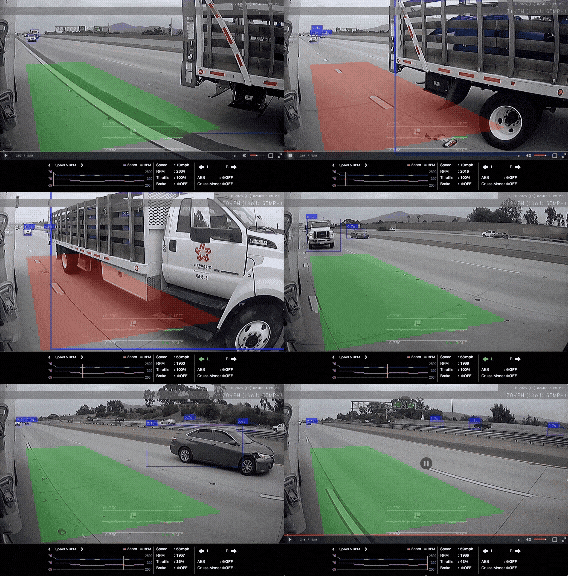
Lorsqu'un conducteur active un indicateur de virage, l'assistance de vision latérale vérifie la voie adjacente à l'aide de caméras latérales. Si un véhicule, un cycliste ou un piéton s'y trouve déjà, le conducteur reçoit une Alerte immédiate dans la cabine, au moment de la décision, et non après que le changement de voie soit devenu un incident.
Cette conception basée sur les signaux est importante parce qu'elle permet de concentrer les alertes sur les scénarios qui génèrent réellement des réclamations. Le système ne surveille pas constamment et ne gazouille pas le bruit. Il s'active lorsque le conducteur déclare son intention de se déplacer, et il ne réagit que lorsqu'il y a quelque chose sur le chemin.
Pourquoi les conducteurs l'utilisent réellement
La fatigue en état d'alerte est la cause discrète de la technologie de sécurité de la flotte. Les conducteurs retirent les systèmes qui crient loup, et les équipes de sécurité héritent des retombées : plus d'examens manuels, moins de confiance dans les outils.
L'assistance à la vision latérale est conçue pour éviter ce piège :
- Le bon moment : Ne se déclenche que lorsque le conducteur signale un changement de voie, et non pendant la conduite en ligne droite.
- Signification claire : Ce n'est pas un vague avertissement. Il indique au conducteur que la voie adjacente est occupée.
- Bruit réduit : L'activation basée sur le signal filtre la plupart des non-événements.
Le résultat est que les conducteurs d'outils sont plus susceptibles de faire confiance et une équipe de sécurité qui passe moins de temps à trier les faux positifs.
L'analyse de rentabilisation : moins d'incidents, moins d'exposition
Chaque flotte connaît les coûts directs d'une collision latérale : les factures d'atelier de carrosserie, un camion hors route et un expert en sinistres au téléphone.
Ce qui se passe le plus rapidement, c'est tout ce qui se passe autour de ces coûts. La fréquence croissante des réclamations pour impact latéral entraîne un frein opérationnel pour les équipes de sécurité et des opérations. Les incidents impliquant des usagers de la route, des véhicules, des cyclistes ou des piétons vulnérables peuvent augmenter considérablement la responsabilité et l'exposition au règlement. Et lorsque les seules données arrivent après la collision, l'entraînement devient réactif par définition.
L'assistance à la vision latérale est conçue pour réduire la fréquence des incidents évitables liés au changement de voie. C'est l'un des leviers les plus efficaces dont dispose une flotte pour réduire le coût total du risque sans augmenter les effectifs.
Partie d'un tableau complet
L'assistance à la vision latérale fait partie de la plateforme 360 AI de Netradyne sur le Driver•i™ D-810, offrant une visibilité surround avec jusqu'à huit caméras.
C'est important parce que le risque secondaire se produit rarement de manière isolée. Les changements de voie, les fusions, les virages et la conduite urbaine dense sont des moments pleins de scène. Plus la vue autour du véhicule est complète, plus le conducteur est confiant et plus le contexte est fiable lorsque votre équipe doit reconstituer ce qui s'est passé.
Conclusion
Les accidents survenus lors d'un changement de voie sont fréquents. Les angles morts sont bien réels. Les miroirs seuls ne suffisent pas.
L'assistance à la vision latérale donne aux conducteurs un avantage concret : une alerte dans la cabine, déclenchée par leur propre clignotant, qui leur indique quand la voie adjacente est occupée. C'est de la prévention au moment de la décision, pas une autre vidéo à revoir demain.


Vous voulez protéger les conducteurs et réduire les coûts ?
Ce n'est pas une question trompeuse. Voyez par vous-même avec une démo.