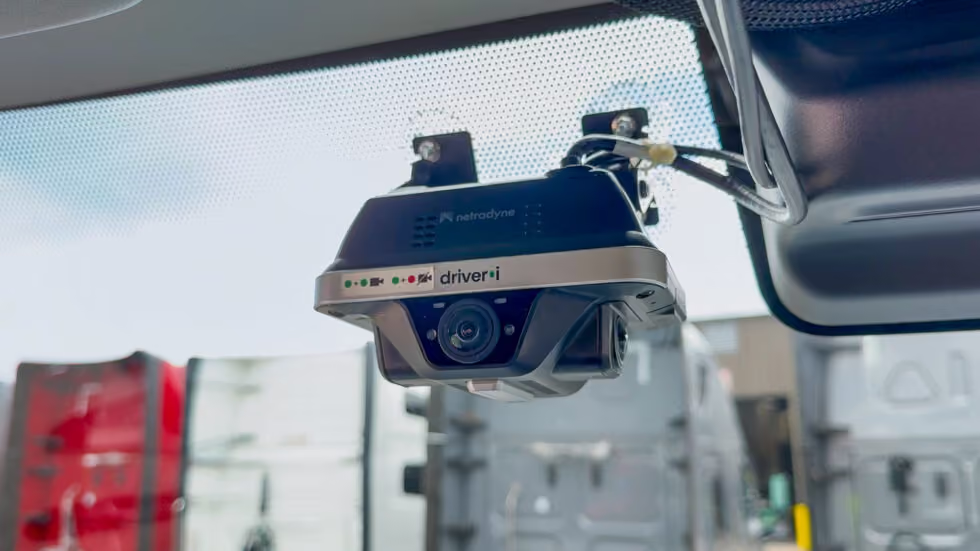
As a customer marketer at Netradyne, I regularly speak with fleets about the operational and safety challenges they face and the strategies they're using to address them. Those conversations provide firsthand insight into what drives technology decisions across industries. Two challenges consistently rise to the top: protecting drivers and providing evidence to exonerate them when they're not at fault.
U.S. Xpress found a way to turn those challenges into opportunities by recently partnering with Netradyne to modernize the technology in their trucks. Through this partnership, they’re able to give drivers best-in-class tools, recognize the work they do every day, and help them build long, successful careers on the road.
Cameras protect drivers, and better data changes coaching
For most carriers, in-vehicle cameras have become standard equipment for two key reasons: they give safety teams the context to coach drivers through challenging situations and they provide objective evidence when incidents occur.
"In most cases, accidents on the road are not the fault of the truck driver," Daniel Pemberton, Senior Vice President of Safety and Driver Development, explained. "It's the other vehicle cutting them off or doing something they shouldn't. Video evidence often shows that truck drivers did the right thing; they were following the rules of the road."
David Tomshack, Senior Director of Safety, has seen that difference throughout his career reviewing collisions. Before cameras, preventability decisions often depended on police reports or witness statements that did not always capture the full story.
"Now, with Netradyne, we can actually go in and review the video and make those determinations easier," he said. "More often than not, it protects the driver."
Moving beyond moments to understand the whole drive
Traditional camera systems often rely on triggers such as hard braking or sudden lane changes. While these events can provide valuable insight, they capture only a brief snapshot of what happened, offering a limited view of a driver's overall performance. As Pemberton explains, "You're getting a very limited snapshot of something that went wrong.Inherently, you're missing the bigger picture of that driver's performance."
That limitation affected how many drivers viewed camera programs. When technology only highlights mistakes, drivers hear about what went wrong but rarely receive recognition for the safe decisions they make every day.
Netradyne analyzes 100% of drive time with valuable context, helping safety teams understand a more accurate picture of driver performance. Instead of focusing only on events, the platform recognizes safe behaviors and creates opportunities for meaningful coaching.
"With the Netradyne camera, we have the opportunity to credit a driver and praise them for a job well done," Tomshack said. "Before, they might do good things, but we had to go find them. Now the system calls it out and gives that driver the recognition."
The U.S. Xpress safety team tested it first
Before introducing the technology to drivers, Pemberton and Tomshack installed Netradyne cameras in their personal vehicles to experience the system firsthand.
"I thought I was a pretty safe driver, and I did a lot of the right things," Pemberton said. "But I also had things to work on. My commute is long, with highways and congested areas, and it takes real work to be a safe driver. You have to constantly manage your space."
For Tomshack, who spent more than 20 years behind the wheel earlier in his career, the experience reinforced how demanding professional driving can be.
"It gives you the opportunity to experience what a driver goes through every day, with the congestion, people cutting you off, all of it," he said. "It gave me the chance to change some of my own behavior too."
That firsthand testing helped shape the rollout. U.S. Xpress has now deployed the technology across roughly 80 trucks, giving drivers real experience with the system before a broader implementation on their fleet of 6,000 trucks.
Recognition and self-correction built into every mile
A key part of the Netradyne approach is the GreenZone® Score. Out of a possible 1,050 points, the score reflects both coachable moments and the safe behaviors drivers demonstrate every day.
"That is one of the reasons we chose Netradyne after looking at multiple vendors. They do such a good job of recognizing the good a driver does and building it into the score. The goal is improvement."
- Daniel Pemberton, Senior Vice President of Safety and Driver Development
The same platform helps drivers correct course before a behavior becomes an event. Because Netradyne's Edge AI processes information directly on the Driver•i D-450 device, feedback reaches the driver immediately. Someone following too closely gets an alert, eases off, and avoids the situation entirely.
.avif)
Drivers can take ownership of their progress too, using the mobile app to review their performance and see how they’re trending over time. Across Netradyne customers, this recognition-based approach drives 2 to 3 times higher driver engagement and retention.
Addressing driver questions
Like any new technology, camera programs raise questions, and U.S. Xpress wanted drivers to know the system is built to support them and help them improve.
Because the cameras process information on the device, footage stays tightly controlled, with access limited to authorized teams. The technology is also built to read complex driving environments like construction zones, frontage roads, and intersections, and when an event calls for a closer look, the U.S. Xpress safety team makes the final decision.
An investment in drivers
For Pemberton, the partnership comes down to supporting the people behind the wheel.
"We're investing in this technology for our drivers. We want to give them the tools they need to be safe and successful, so they can build a long career in trucking. It's a two-way conversation about the things they do well and the opportunities to keep growing."
- Daniel Pemberton, Senior Vice President of Safety and Driver Development
Tomshack summarized the value simply. "I really like that it gives the driver the chance to self-correct. Things happen out there. But if the system brings it to their attention and they don't repeat the behavior, it's a win for all of us."
U.S. Xpress is one example of how companies are building safer fleets by empowering drivers with the tools, insights, feedback, and recognition they need to succeed. Through recognition-based coaching, complete driving context, and real-time intelligence, Netradyne helps fleets move toward a shared vision: safer drivers, safer roads, and stronger careers across the transportation industry.
If you’d like to hear this conversation firsthand, check out U.S. Xpress’ podcast recording here.


Kas soovite kaitsta autojuhte ja vähendada kulusid?
See pole trikkiküsimus. Vaadake ise demoga.