ATRI report: record trucking costs in 2025 and what fleets can do about it
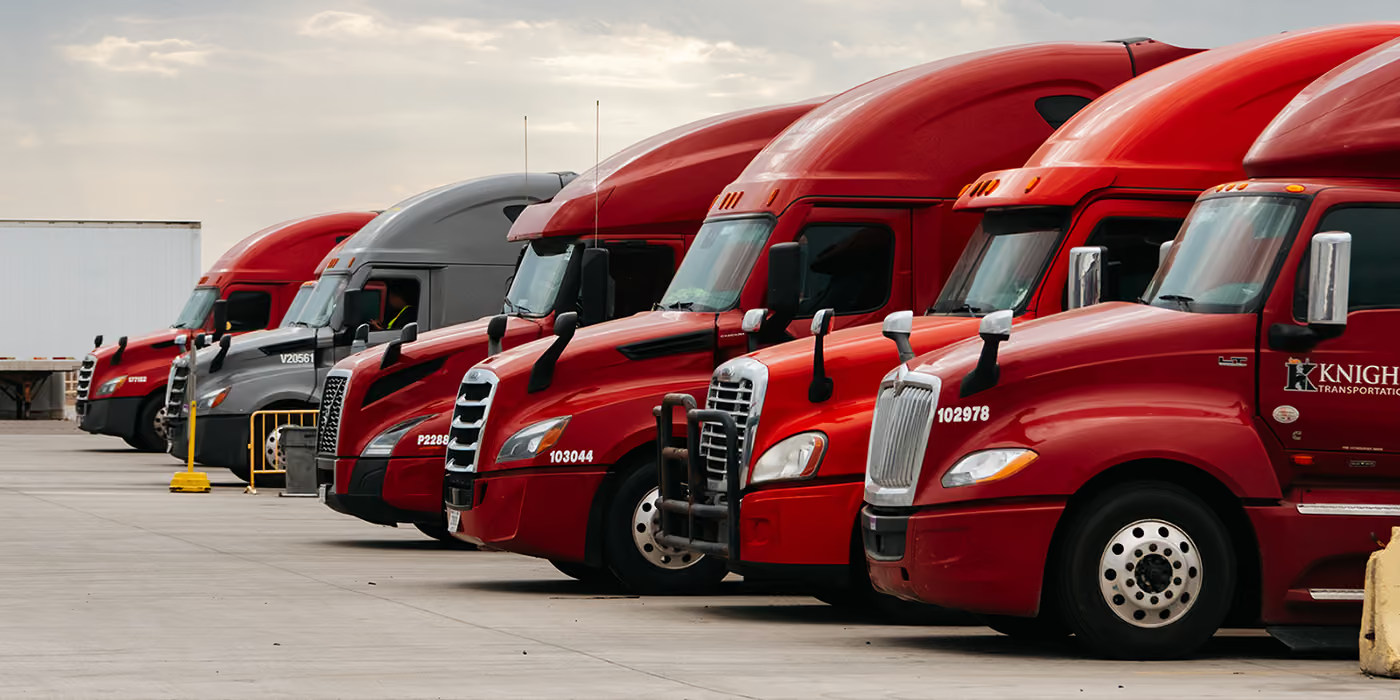
The American Transportation Research Institute (ATRI) just released its 2025 operational cost analysis, and the findings are stark. Average trucking costs reached $2.336 per mile, a new record. Driver wages and benefits exceeded $1.00 per mile for the first time. Repair and maintenance costs jumped 8.6%. Insurance premiums rose 3.9%.
It's not a single cost driver creating margin pressure. It's nearly every cost category rising simultaneously while pricing power remains flat. These increases came during one of the industry's toughest freight environments in recent memory.
Traditional cost-cutting strategies won't solve this. The path forward requires fleets to improve operational execution where it matters most: driver retention, maintenance efficiency, incident prevention, and fuel optimization. That's the difference between fleets that survived 2025 and those that actually adapted.
Driver wages and retention: the $1 per mile problem
ATRI data showed that combined driver wages and benefits hit $1.01 per mile in 2025, up from $0.97 the prior year. That's the largest single operating expense, growing faster than freight rates.
The industry response has largely focused on wages: pay drivers more to recruit and retain them. But fleets that won in 2025 found that wage increases alone don't solve retention. Drivers still leave for competitors, better opportunities, or burnout.
Netradyne's platform drives 2-3× higher driver engagement and retention through recognition-based coaching and GreenZone® scoring. When drivers see their full performance picture—safe behaviors recognized alongside coaching opportunities—they engage more actively with the platform and stay longer with the fleet.
Consider Rumpke Waste & Recycling, which deployed Netradyne across 2,700+ hauling vehicles. By shifting from punitive monitoring to real-time recognition-based coaching, Rumpke improved driver trust and participation. Or J.L. Rothrock, which used Netradyne's recognition programs like the "900 Club" for high-performing drivers to foster healthy competition and peer-supported improvement across their 70+ driver fleet.
When retention improves, fleets eliminate the compounding costs of turnover: recruiting, training, lost productivity, and onboarding time. One avoided driver departure recovers costs quickly in a margin-constrained environment.
Maintenance costs at 8.6% growth: prevention vs. emergency
The second-largest cost surge came from repair and maintenance, up 8.6% year-over-year. With average truck age reaching 3.6 years in 2025, vehicles are staying in service longer, which shifts the cost equation from purchasing to uptime and reliability.
An unexpected breakdown isn't just a repair bill. It's lost revenue while the truck sits idle, driver reassignment, missed deliveries, and customer impact. One transmission failure in the field can cost thousands more than preventative maintenance scheduled during planned downtime.
Netradyne's fleet management solution identifies maintenance patterns and component degradation before problems become breakdowns. Instead of reacting to a failure, you schedule service based on actual driving data and vehicle conditions. The difference between a $5,000 emergency breakdown and a $500 scheduled service compounds across a fleet.
This preventative approach directly addresses ATRI's data: when you reduce unexpected downtime, you reduce the margin impact of rising maintenance costs. Infrastructure and construction fleets have found particular success with this approach. Allan Myers, which operates 1,600 vehicles across dispersed job sites, achieved a 48% reduction in fleet incidents by integrating predictive maintenance with real-time safety coaching, allowing teams to schedule both service and driver coaching proactively.
Incident-related costs: reducing the impact of collisions
Insurance premiums climbed 3.9% in 2025. Beyond the premium itself, fleets know that incidents and collisions create secondary costs: claims handling, driver discipline, vehicle repair, and elevated future rates.
Netradyne's AI-powered safety platform reduces incident frequency through real-time coaching. Built on analysis of 30 billion miles and 150 billion minutes of driving data, the platform delivers approximately 99% alert accuracy with coaching that drivers actually respond to.
This isn't surveillance that punishes drivers. It's trust-based coaching that helps drivers prevent incidents before they happen. When a driver drifts toward another vehicle or approaches a hazard, real-time in-cab alerts let them correct course immediately.
The results from fleets that deployed this approach in 2024-2025 speak clearly. Caffey Distributing, a food and beverage distributor, achieved a 25% reduction in incidents with over 90% voluntary driver app engagement. Pet Food Experts reduced average claims costs by 75% and total annual claim payouts by 80%. Most notably, J.L. Rothrock eliminated $1.2 million in annual claims and achieved zero DOT-recordable accidents in 2024, while paying out $90,000+ in annual safety performance bonuses to high-performing drivers.
A 50-point improvement in GreenZone® Score correlates with 13-15% fewer accidents per million miles. Fewer incidents mean lower incident-related costs, defensible video evidence when claims occur, and reduced exposure to liability. For many fleets, preventing even one serious collision pays for the platform multiple times over.
Fuel efficiency: behavior patterns driving costs
While fuel costs remained relatively stable in 2025 (up just 0.2%), ATRI data showed that early 2026 brought fuel cost increases approaching 6%. More importantly, fuel inefficiency is driven by specific behaviors: aggressive acceleration, excessive idling, poor route selection, and neglected tire pressure.
Netradyne's driver coaching identifies and targets fuel-waste patterns. The approach improves fuel efficiency without compromising safety. In fact, fuel-efficient driving and safe driving share underlying behaviors: smooth acceleration, steady speeds, anticipatory braking, and attentive route selection.
This creates a margin win that doesn't require capital investment or new equipment. Coaching that improves both safety and fuel efficiency delivers dividends across every mile.
Unified visibility vs. fragmented data
Most fleets manage safety, operations, and compliance through disconnected systems. Safety teams track incidents. Operations teams monitor fuel and maintenance. Compliance teams track ELD data. When these systems don't communicate, insights get lost and execution suffers.
Netradyne unifies safety, operations, and compliance visibility on one platform. This means behavior patterns that affect both safety and fuel efficiency are visible together. Coaching targets behaviors that matter most. Predictive maintenance alerts appear alongside driver behavior data. The full picture drives better decision-making across the organization.
What this means for 2026 and beyond
ATRI's report makes clear that fleets can't negotiate their way out of rising costs. Wage cuts compromise recruitment and retention. Equipment cuts compromise safety. Rate increases face market headwinds.
What works is improving execution where costs originate. That means building driver retention through recognition, preventing maintenance failures through predictive alerts, reducing incidents through real-time coaching, and optimizing fuel efficiency through behavioral change. These improvements compound.
Fleets that won in 2025 despite margin pressure weren't those with the biggest budgets or the deepest cost cuts. They were the ones using data and AI to improve how drivers operate, how maintenance gets managed, and how safety culture gets built.
That approach becomes more critical in 2026. When every cost is rising and pricing power is limited, intelligent execution is the lever that matters.
Ready to improve your operational efficiency?
Book a demo today and see how Netradyne helps fleets reduce incidents, retain drivers, prevent downtime, and optimize fuel efficiency on one integrated platform.


Kas soovite kaitsta autojuhte ja vähendada kulusid?
See pole trikkiküsimus. Vaadake ise demoga.