When the yellow buses return

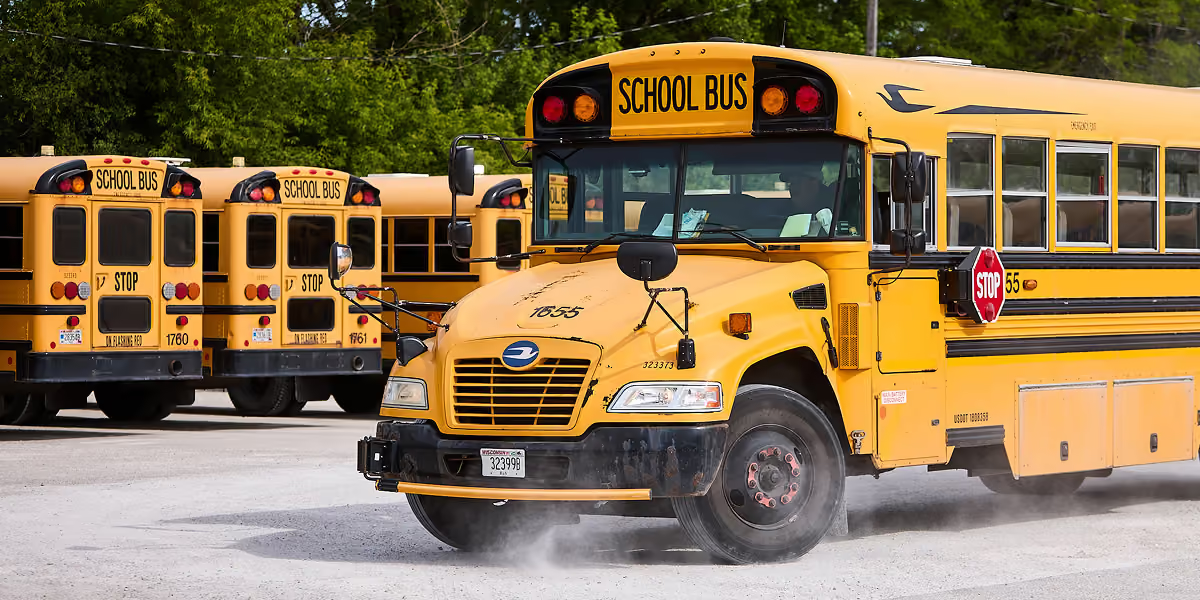
It was a warm August morning and felt more akin to summer than the beginning of school. A delivery driver, already behind schedule after construction delays, rounded a curve on a two-lane road and saw a yellow school bus ahead. Its warning lights had begun to flash.
For a moment, he looked past the bus instead of at it. He checked the clock, glanced at his mirrors, and wondered whether he could get around before it stopped. In that small window, the red lights began flashing, and the stop arm extended.
He did not see it.
As he moved left to pass, a child stepped into the roadway after exiting the bus. The driver slammed on the brakes and stopped just feet away. No one was hurt, but the result could have been very different. One missed cue, one rushed decision, one moment of divided attention turned an ordinary morning route into a near tragedy.
School bus season changes the roadway
As the last few weeks of summer give way to the school year, school buses return to neighborhoods, rural highways, suburban arterials, and city streets. For months, many drivers have not had to adjust for frequent bus stops, children waiting near curbs, or changing school-zone traffic patterns. That changes quickly once routes begin again.
The National Highway Traffic Safety Administration notes that each school day, millions of children ride school buses and that school buses are among the safest vehicles on the road. But NHTSA also emphasizes that children are more at risk when approaching or leaving the bus, when they are walking, waiting, crossing, or stepping into traffic.
This is why every driver, whether operating a passenger car, pickup, service van, dump truck, box truck, or tractor-trailer, has a direct role in school bus safety. A stop arm is not a suggestion. It is a warning that a child may be entering a space where every driver must already be stopped.
The stop arm is a line drivers must not cross
NHTSA explains that yellow flashing school bus lights mean the bus is preparing to stop to load or unload children, and drivers should slow down and prepare to stop. Red flashing lights and an extended stop arm mean the bus has stopped, and children are getting on or off. Drivers must stop and wait until the red lights stop flashing, the stop arm is withdrawn, and the bus begins moving again before proceeding.
The problem is that too many drivers still pass stopped school buses. In its best-practices guide on school bus passing, NHTSA reports that a 2023 survey by the National Association of State Directors of Pupil Transportation Services estimated more than 38.4 million illegal school bus passings in the United States during the 2025-2026 school year. That number is not just a transportation statistic. It represents repeated moments where children were exposed to preventable risk.
The opening story is fictional, but the behavior behind it is familiar: a driver in a hurry, a changing traffic pattern, a missed signal, and a vulnerable child near the roadway.
Look beyond the bus
When a school bus is slowing or stopped, drivers should not focus only on the vehicle itself. They should scan the space around it: shoulders, sidewalks, driveways, intersections, ditches, yards, and the front of the bus. Children may move unpredictably. They may drop a phone or backpack, run to catch the bus, or cross the road after the bus driver signals them to proceed.
NHTSA advises children to wait at least ten feet from the curb and, when crossing in front of a bus, to move to a place at least ten feet in front of the bus so the driver can see them. The National Safety Council also reminds drivers to stay alert, avoid distracted driving, obey school zone speed limits, make eye contact with children crossing the street, and never pass a bus loading or unloading children.
Those reminders are the difference between assuming the road is clear and confirming that it is safe.
Commercial drivers need more space and more time
For commercial drivers, the stakes are even higher because vehicle size, weight, visibility, and stopping distance all change the safety equation. The Federal Motor Carrier Safety Administration highlights long stopping distances as a key safety challenge for large trucks and buses. A professional driver approaching a school bus cannot rely on a last-second reaction. The margin must be built early through speed management, following distance, and disciplined visual scanning.
This is especially important on rural roads, where buses may stop on higher-speed routes, near curves, over hills, or at driveway pickups, and in urban areas near parked vehicles, crosswalks, bike lanes, and school traffic.
Whether the vehicle is a fully loaded tractor-trailer or a family SUV, the right response is the same: slow early, cover the brake, create space, and expect a child to appear.
A back-to-school commitment for every driver
Back-to-school safety is not only a school district issue. It is a roadway culture issue. Every driver contributes to the environment children experience when they travel to and from school.
That means putting the phone away before the route begins. It means leaving earlier so the pressure of being late does not influence decisions. It means treating yellow flashing lights as a command to prepare, not a challenge to beat the stop. It means recognizing that a few seconds saved can never compare to the lifetime impact of a preventable injury.
The next time you see a yellow bus slowing ahead, remember the child you cannot yet see. Remember that every stop arm represents a family, a classroom, and a community trusting the rest of us to do the right thing.
School buses are coming back to the road. So are children. Our job, as drivers, is to make sure they all get home safely.


Vous voulez protéger les conducteurs et réduire les coûts ?
Ce n'est pas une question trompeuse. Voyez par vous-même avec une démo.