From Reviewing to Preventing Driver Distraction Incidents
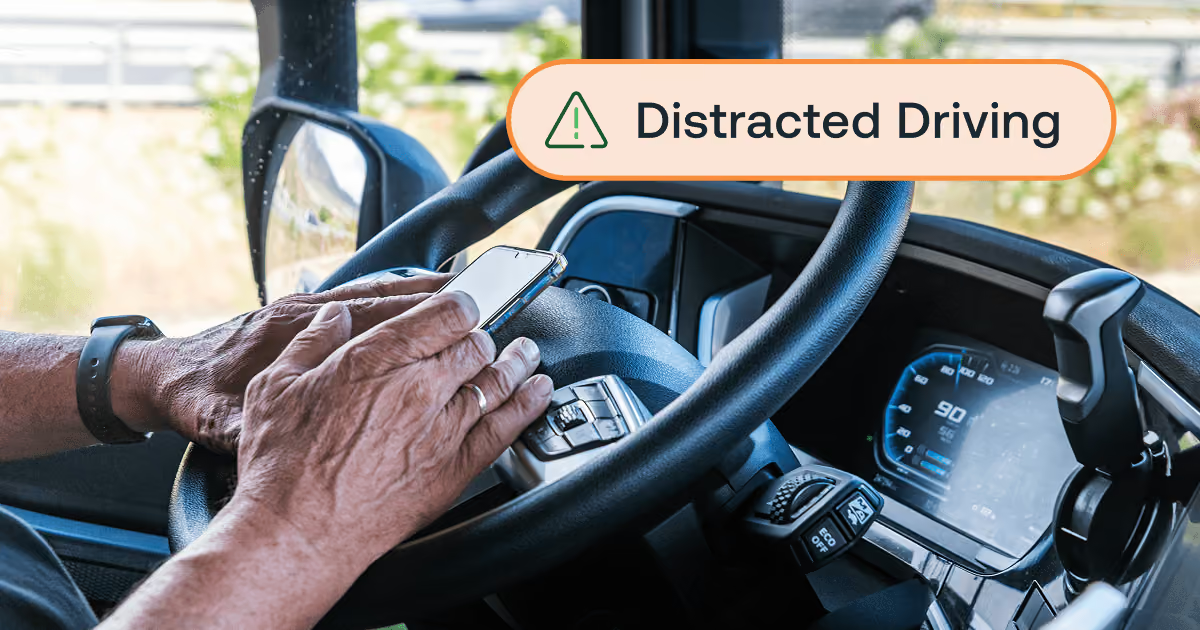
Distracted driving killed 3,275 people in the U.S. in 2023, according to NHTSA1. Drowsy driving killed another 633 that same year2. And NHTSA acknowledges that drowsy-driving fatalities are likely undercounted3. CDC's NIOSH puts the real scale in sharper terms: driver fatigue may be involved in as many as one in five fatal crashes4.
The categories are different. The outcome is the same.
A driver's attention leaves the road. The vehicle keeps moving. The path begins to shift. Reaction time drops. Risk compounds in seconds. By the time a single-event detection system flags the moment, the moment has already passed.
That's the gap most fleet safety systems don't close. They're built to log what happened. Distraction flagged. Drowsiness detected. Clip saved.
Netradyne is built to read what's developing. Not just whether a driver looked away, but whether the vehicle is drifting, whether the road edge is getting closer, whether a collision threat is forming ahead. When those signals converge, the system responds in the moment, not in a report the next morning.
That's the difference between a record of risk and a reason it didn't become a crash.
Detection is not the same as prevention
Most in-cab cameras can tell you if a driver is looking away. Some can flag signs of drowsiness. But a flag is not a response. Detection by itself does not change what happens next.
What matters is whether the system understands the risk behind the behavior. A driver who glances down for two seconds on an open highway is not the same risk as a driver who is looking down while drifting toward a cyclist. The behavior looks identical in a single-signal system. The danger is completely different.
When a system can only read one signal at a time, it does one of two things: it misses real risk, or it flags everything and buries your safety team in footage they have to sort through manually. Neither outcome helps the driver. Neither outcome helps you.
Netradyne evaluates multiple signals together- lane position, road-edge proximity, forward collision threat, and driver attention. It processes all of it at the edge, in real time, so the system can act while the prevention window is still open. Not only in a report. Not only in a coaching session three days later. In the moment the risk is building.
Lane Departure Warning: when distraction starts changing vehicle path
One of the earliest signs that attention is breaking down is straightforward: the vehicle starts to drift.
Lane Departure Warning detects when your driver crosses a lane line, whether the vehicle is drifting unintentionally or the driver becomes distracted during the maneuver. That matters because lane drift is often the first visible sign that distraction or fatigue has moved beyond a driver-state issue. It is now affecting vehicle control.
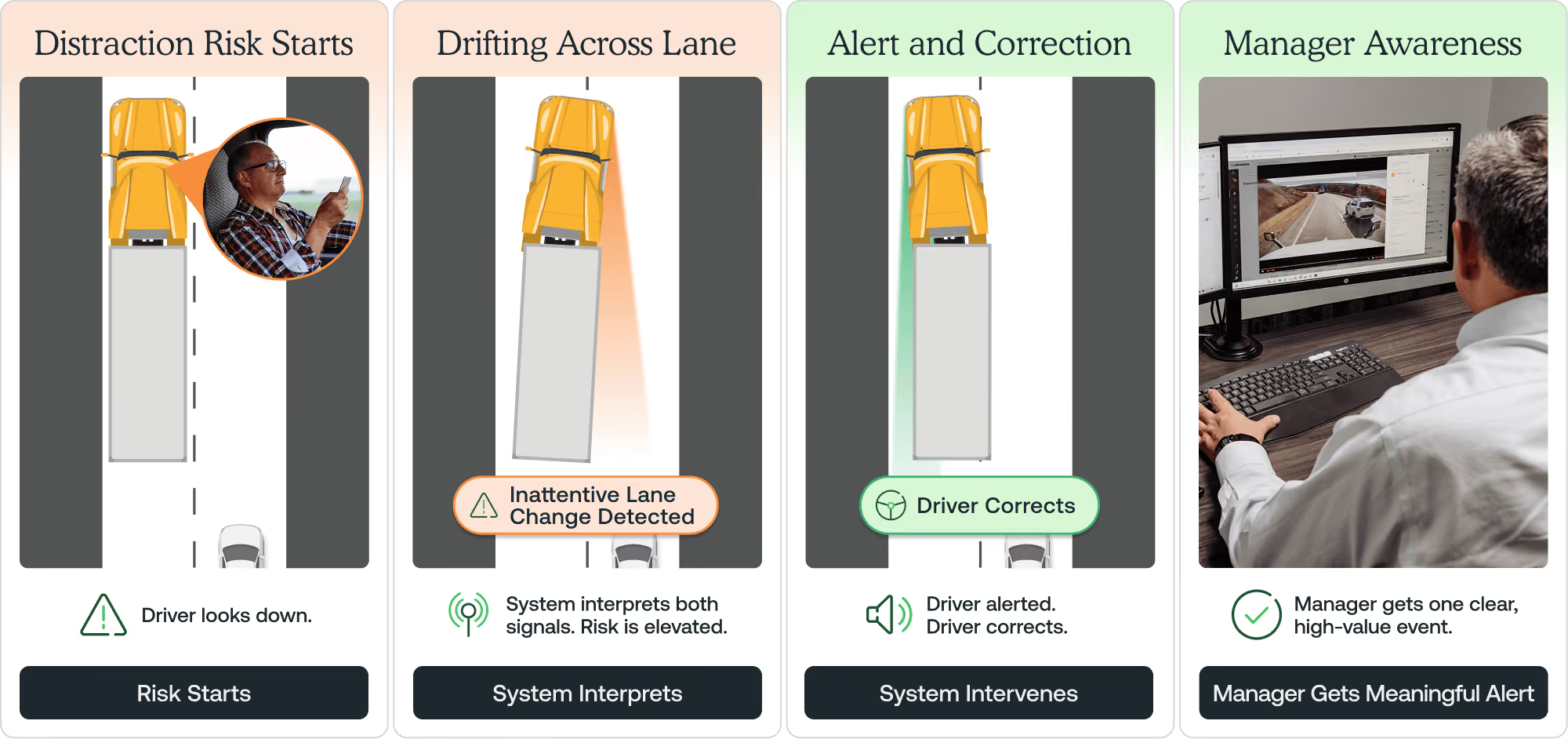
For your drivers, that means an immediate in-cab alert tied to a specific behavior rather than a vague attention flag. For your safety team, it creates a coaching event anchored to actual vehicle movement, something concrete to address rather than a clip to interpret. That distinction reduces review time and makes coaching conversations faster and more defensible.
Road Boundary Warning: catching the drift that lane alerts miss
Not every dangerous drift ends at a lane line.
Some of the highest-risk moments happen when a vehicle moves toward the shoulder or road edge. At that point, the issue is no longer lane discipline. It is loss of path control. Road-edge drift is one of the clearest precursors to run-off-road events and correlates strongly with fatigue-related driving behavior.
Road Boundary Warning surfaces that movement before it becomes an incident. Together with Lane Departure Warning, it gives your safety team broader visibility across the full spectrum of path deviation, from lane-level drift to boundary-level risk.
Distracted Driving Lane Departure: when two weak signals become one strong one
A distraction event on its own is useful data. A lane departure event on its own is useful data. Together, they tell a different story.
Distracted Driving Lane Departure detects when your driver is looking down or at a phone while the vehicle crosses a lane line. Instead of logging those as two separate events, the system combines them into a single, more specific alert: ‘Inattentive Lane Change Detected.’
That specificity matters at every level. The driver hears a warning that matches the actual risk, not a generic tone. Your safety team gets one contextualized coaching event instead of two disconnected data points. Your reporting reflects combined risk, which means your event totals are more accurate and your coaching conversations are more focused.
This is where multi-signal processing starts to separate itself from detection-only approaches. The system is not counting behaviors. It is recognizing when behaviors compound to create a more serious threat.
Distracted Driving Collision Warning: giving inattentive drivers more time to react
A distracted driver does not have the same reaction window as an attentive driver. A well-designed collision warning system should account for that.
Distracted Driving Collision Warning increases warning sensitivity when your driver is looking away. For Forward Collision Warning and Pedestrian Collision Warning, that means the alert fires earlier when the system detects reduced attention.
Most fixed-threshold systems assume the driver is ready to respond. Real roads do not work that way. A driver looking at a phone is already behind the moment before the threat registers. By triggering the alert earlier, the system buys back reaction time precisely when reaction time matters most. That is not a minor adjustment. It is the difference between a warning that changes behavior and one that arrives too late to matter.
Advanced Drowsy Warning: detecting the risk that builds before it shows
Distraction is often visible. A driver reaches for a phone. Eyes leave the road. The behavior has a clear signal. Drowsiness is harder to catch because it does not announce itself. Fatigue builds gradually. A driver can appear to be facing forward, eyes open, while their alertness is already declining. By the time the behavior looks dangerous, the window to intervene may already be closing. That is why most in-cab cameras are not enough for early drowsiness detection. They are not purpose-built for it.
Netradyne's DMS Sensor detects early fatigue indicators, including extended eye closure, intermittent eye closure and changes in blink velocity to detect fatigue before the driver is visibly nodding off and well before the event appears in a post-incident review.
The sensor uses infrared technology and works in the dark and through non-polarized sunglasses, which matters for real-world fleet conditions where drivers are not going to change their habits to accommodate the equipment.
Drowsiness does not appear all at once, the alerting should not either. DMS Sensor detects multiple signals together to determine severity and escalate the response severity based on what the driver is showing in the moment. The result is earlier detection of fatigue-related risk, the kind that does not wait until a driver's head drops to act.
Why the full stack matters
Each of these capabilities solves a different part of the same problem: driver attention and fatigue risk is not static, and it does not unfold in one dimension.
Lane Departure Warning detects when reduced attention starts changing vehicle path. Road Boundary Warning extends that visibility to edge-of-road movement, where some of the highest-risk departures begin. Distracted Driving Lane Departure identifies the moment when driver state and vehicle behavior combine into a more serious threat. Distracted Driving Collision Warning adjusts warning timing to the driver’s actual attention state, helping recover reaction time when it matters most. And the DMS Sensor adds another critical layer, using dedicated driver monitoring and progressive alerting to detect fatigue-related risk and escalate response as severity builds.
That is the power of the stack. It does not treat distraction, drowsiness, lane movement, and collision risk as separate events to log after the fact. It interprets them together, in context, while there is still time to intervene.
Every added layer sharpens the system’s understanding. Every added signal improves the quality of the next decision. This is not more noise. It is better judgment. The system is continuously building a more accurate picture of what is happening with the driver, the vehicle, and the road around them, then turning that understanding into action.
That is what better safety technology should do. Not just observe risk. Interrupt it.
Distracted driving is not one moment. Drowsy driving is not one moment either. Both are developing patterns of degraded attention that alter vehicle behavior, reduce reaction time, and increase the likelihood of a preventable incident.
Your fleet does not need more cameras that capture those moments for later review. It needs a system that can recognize when attention loss is becoming path deviation, when path deviation is becoming collision risk, and when the right warning can still change the outcome.
That is the standard modern fleet safety should be held to.
Netradyne is built for that standard.
See how it works in practice
See how Netradyne helps fleets detect driver attention risk earlier and turn alerts into faster, more focused intervention. Request a demo.
Sources:
- Distracted driving killed 3,275 people in the U.S. in 2023
Source: NHTSA press release, “Put the Phone Away or Pay 2025 Campaign Launched.” It states that “in 2023, an estimated 324,819 people were injured and 3,275 were killed in distracted-driving-related crashes.”
- Drowsy driving killed 633 people in 2023
Source: NHTSA’s Drowsy Driving page. It lists “633 deaths from drowsy-driving-related crashes in 2023.”
- NHTSA says drowsy-driving fatalities are likely undercounted
Source: the same NHTSA Drowsy Driving page. It says precise numbers are hard to determine and that there is “broad agreement” the impact of drowsy driving is underestimated in official reporting.
- Driver fatigue may be involved in as many as one in five fatal crashes
Source: CDC NIOSH, Driver Fatigue on the Job. It states: “As many as one in five fatal crashes in the general population involve driver fatigue.”


هل تريد حماية السائقين وخفض التكاليف؟
هذا ليس سؤالًا خادعًا. شاهد بنفسك مع العرض التوضيحي.